

The Preference Point System governs how applicants are ranked on the Section 8 housing waitlist administered by the Western Piedmont Council of Governments (WPCOG). By assigning priority based on residency, disability, veteran status, and homelessness, the system determines who gains access first to limited housing assistance across four counties in western North Carolina.
Table of Contents
Preference Point System
| Key Fact | Detail |
|---|---|
| Program | Housing Choice Voucher (Section 8) |
| Administrator | WPCOG Regional Housing Authority |
| Ranking Method | Preference points, then application date/time |
| Coverage Area | Alexander, Burke, Caldwell, Catawba counties |
Understanding the Preference Point System
The Preference Point System is a structured method used by housing authorities to rank applicants when demand for assistance far exceeds available resources. At WPCOG, the system applies to the federal Housing Choice Voucher program, commonly known as Section 8.
Rather than operating on a first-come, first-served basis alone, WPCOG assigns numerical points to applicants who meet specific eligibility criteria. These points reflect policy priorities set at both the federal and local levels.
According to WPCOG policy documents, applicants with the highest preference point totals are placed closer to the top of the waitlist. When two applicants have the same score, the application submission date and time serve as a tiebreaker.
Housing officials emphasize that the system is designed to be transparent and compliant with federal law. “Preferences are applied uniformly and only when eligibility can be verified,” WPCOG states in public-facing guidance.
Why Preference Points Exist
Federal housing assistance programs face chronic underfunding relative to demand. According to data from the U.S. Department of Housing and Urban Development (HUD), only about one in four income-eligible households nationwide receives federal rental assistance.
As a result, housing authorities must make policy choices about how to allocate scarce vouchers. HUD allows local agencies to adopt preference systems as long as they are nondiscriminatory and clearly documented.
The Preference Point System reflects this balance. It prioritizes households considered to have greater or more urgent housing needs while maintaining consistency and accountability in decision-making.
Preference Categories and How Points Are Assigned
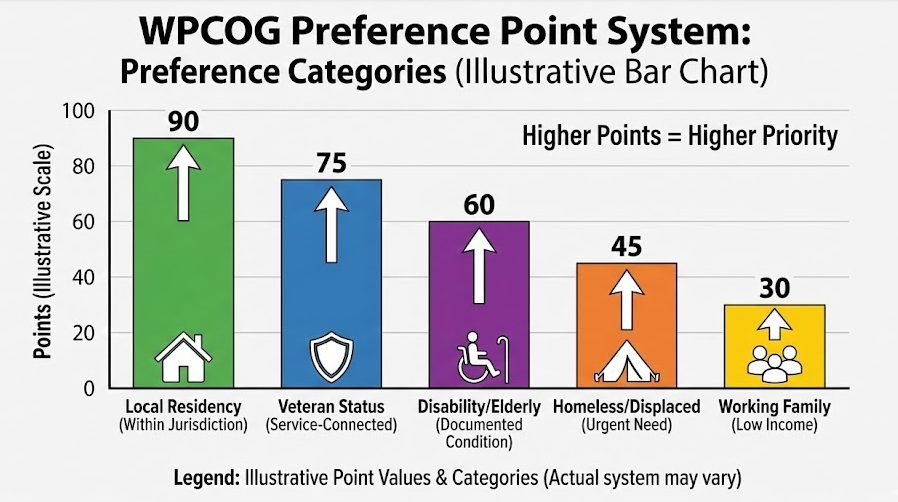
Local Residency Preference
Applicants who live or work within WPCOG’s service area—Alexander, Burke, Caldwell, or Catawba counties—receive the highest number of preference points.
Local officials say this policy helps stabilize communities by assisting residents who already have ties to the region. It also aligns housing assistance with local workforce and social service networks.
Residency must be documented through employment records, leases, utility bills, or other verifiable proof.
Disability Preference
Households that include at least one member with a verified disability qualify for additional preference points. HUD defines disability broadly, encompassing physical, mental, and developmental impairments that substantially limit major life activities.
Housing authorities are required by law to provide reasonable accommodations during the application and verification process. WPCOG officials note that medical documentation is typically required but handled confidentially.
Advocates argue that disability preferences are essential because people with disabilities face higher risks of housing instability and limited income opportunities.
Veteran and Military Preference
Veterans, active-duty service members, and surviving spouses of veterans receive preference points under WPCOG policy.
This category reflects federal and state efforts to reduce housing insecurity among military families. HUD data show that while veteran homelessness has declined nationally, affordability challenges remain, particularly in rural and semi-rural areas.
Applicants must provide proof of service, such as discharge papers or military identification, to qualify.
Homelessness Preference
Applicants who meet HUD’s definition of homelessness may receive limited preference points. This definition includes individuals living in shelters, transitional housing, or places not meant for human habitation.
Verification typically comes from service providers, shelters, or government agencies. Housing officials caution that homelessness alone does not guarantee rapid assistance due to the overall scarcity of vouchers.
How Applications Are Ranked and Reviewed
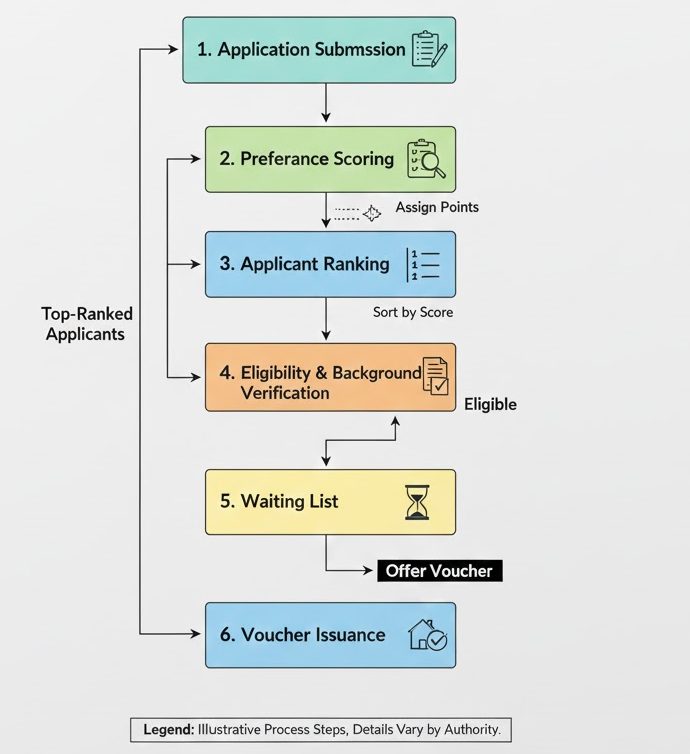
Once applications are submitted during an open enrollment period, WPCOG assigns preference points based on self-reported information. These initial rankings are provisional.
Full verification occurs only when an applicant reaches the top of the waitlist and vouchers become available. At that stage, WPCOG conducts a detailed eligibility review, including income verification, background checks, and confirmation of preference documentation.
Applicants who cannot substantiate their claims may lose preference points or be removed from the list entirely.
Housing officials say this two-stage process helps manage administrative workload while preserving fairness.
The Importance of Maintaining Application Accuracy
Applicants are required to keep their contact information current while on the waitlist. WPCOG communicates primarily by mail and may also use email or phone notifications.
Failure to respond to a request for information or an eligibility interview can result in removal from the waitlist, regardless of preference score.
Changes in household composition, disability status, or residency should be reported promptly. While updates do not reset application dates, they may affect preference eligibility.
Housing Scarcity and Wait Times
Even with preference points, wait times can extend for years. WPCOG periodically closes its waitlist due to overwhelming demand.
HUD funding levels, congressional appropriations, and local housing costs all influence voucher availability. In recent years, rising rents and limited housing supply have intensified pressure on voucher programs nationwide.
Housing policy experts note that preference systems manage scarcity but do not solve it. “Preferences determine order, not outcomes,” said a regional housing analyst familiar with rural voucher programs.
Oversight and Legal Safeguards
WPCOG operates under federal oversight from HUD and must comply with the Fair Housing Act, the Americans with Disabilities Act, and other civil rights laws.
The agency’s administrative plan is subject to public review and outlines how preferences are defined and applied. HUD audits housing authorities periodically to ensure compliance.
Applicants who believe they were treated unfairly may request informal reviews or hearings, depending on the stage of the process.
Community Impact and Local Perspectives
Local governments and nonprofits often coordinate with WPCOG to address housing instability. Social service providers say the preference system helps direct limited resources toward households facing structural barriers.
However, some advocates argue that the system can feel opaque to applicants. They call for clearer communication about wait times and ranking mechanics.
WPCOG officials acknowledge the frustration many applicants experience. In public statements, the agency emphasizes transparency while noting that funding constraints limit flexibility.
What Happens When a Voucher Becomes Available
When funding allows, WPCOG issues vouchers to top-ranked applicants. Selected households attend briefing sessions that explain program rules, tenant responsibilities, and time limits for finding housing.
Voucher holders must locate units that meet program standards and fall within approved rent limits. Landlord participation remains voluntary, which can present additional challenges in tight housing markets.
Looking Ahead
The future of the Preference Point System depends largely on federal housing policy. Proposed changes to voucher funding, landlord incentives, and fair housing enforcement could affect how local authorities operate.
For now, WPCOG officials say the system remains the most equitable method available for managing overwhelming demand.
“Our goal is to apply the rules consistently and serve those with the greatest documented need,” the agency states.
FAQ
Does the Preference Point System guarantee housing assistance?
No. Preference points affect ranking only. Assistance depends on voucher availability and funding.
Can applicants gain preference points after applying?
Yes, if circumstances change and documentation is provided, though application dates remain unchanged.
Is the system required by federal law?
HUD permits, but does not require, preference systems. Local authorities adopt them under federal guidelines.