
Families receiving federal rental assistance can relocate without losing support through Section 8 portability, a long-standing policy within the Housing Choice Voucher program. For households planning a move to Catawba County, North Carolina, understanding how Section 8 portability works is critical, as local rules, housing market conditions, and administrative timelines can significantly affect how quickly assistance continues after relocation.
Table of Contents
Section 8 Voucher
| Key Fact | Detail |
|---|---|
| Federal program | Housing Choice Voucher (Section 8) |
| Mobility rule | Section 8 portability |
| Receiving area | Catawba County, North Carolina |
| Reapplication required | No |
| Who sends paperwork | Initial housing authority |
As housing costs continue to rise nationwide, Section 8 portability remains a vital mechanism for preserving choice and stability for low-income renters. For families moving to Catawba County, understanding the process in advance can make the difference between a smooth transition and prolonged housing uncertainty.
What Is Section 8 Portability?
Section 8 portability allows a household with an active Housing Choice Voucher to move outside the jurisdiction of the public housing authority that originally issued the voucher. The policy applies nationwide and is mandated by federal law, making mobility a built-in feature of the program rather than an exception.
The U.S. Department of Housing and Urban Development (HUD), which oversees the Housing Choice Voucher program, describes portability as a mechanism that gives families “greater choice in where they live,” including the ability to move closer to employment, education, healthcare, or family support.
Unlike many public assistance programs tied to a specific location, Section 8 portability follows the household, provided the receiving jurisdiction administers the voucher program and accepts incoming transfers.
Why Section 8 Portability Exists
The portability provision was strengthened in the 1990s as part of broader federal efforts to reduce concentrated poverty and expand housing choice. Policymakers argued that limiting assistance to a single jurisdiction trapped families in high-cost or high-poverty areas.
Research from housing policy organizations, including the Urban Institute and the U.S. Government Accountability Office, has consistently shown that housing mobility can improve access to safer neighborhoods, stronger schools, and more stable employment opportunities.
Section 8 portability, according to HUD, is intended to ensure that “geography does not become a barrier to opportunity” for voucher holders.
Who Is Eligible to Use Section 8 Portability?
Not every voucher holder can immediately move. HUD regulations require households to meet several baseline conditions before a transfer can begin.
Most importantly, the household must:
- Hold an active Housing Choice Voucher
- Be in good standing with their current housing authority
- Have no unresolved lease violations or outstanding program debts
Some housing authorities impose an initial residency requirement, often requiring families to live in the issuing jurisdiction for at least 12 months before porting. This requirement varies by agency and does not apply universally.
Voucher holders are advised to confirm eligibility directly with their current housing authority before making relocation plans.
Step-by-Step: How Section 8 Portability Works
Step 1: Request Approval From the Initial Housing Authority
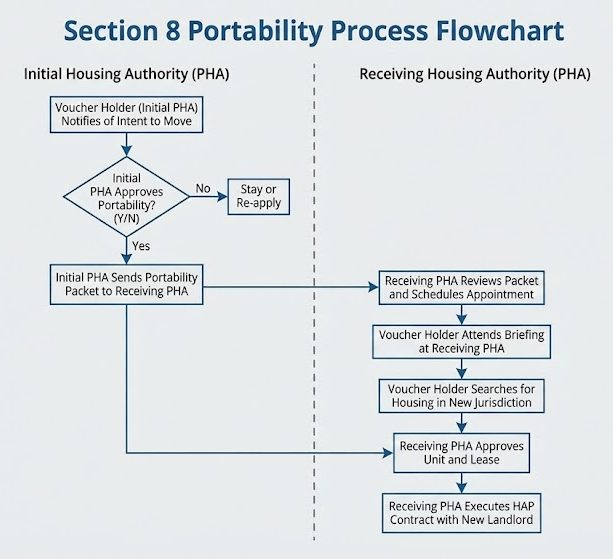
The portability process begins when the voucher holder formally notifies their original housing authority, known as the initial PHA, of their intent to move. This request is usually submitted in writing and must be approved before the household relocates.
HUD rules make clear that families should not move first and request portability later, as doing so can jeopardize assistance.
Step 2: Transfer of Portability Documents
Once approved, the initial housing authority prepares a portability packet that includes:
- Voucher information
- Household composition
- Income verification
- HUD-required forms
This packet is sent directly to the receiving housing authority that serves Catawba County. Voucher holders typically do not handle these documents themselves.
Step 3: Review by the Receiving Housing Authority
After receiving the paperwork, Catawba County’s housing assistance office reviews the file for compliance with local policies and federal rules. At this stage, the agency determines whether it will bill the original housing authority or absorb the voucher.
- Billing means the initial PHA continues paying for the assistance.
- Absorption means the receiving PHA takes financial responsibility and issues a new local voucher.
Both options are allowed under federal law and depend on funding availability.
What Changes After a Voucher Is Ported
While federal eligibility remains the same, local standards can differ significantly.
Payment standards in Catawba County may be higher or lower than those in the household’s previous jurisdiction. Utility allowances, bedroom size determinations, and inspection scheduling practices may also change.
Housing experts caution that these differences can affect affordability. A unit that was affordable in one county may not qualify under another county’s standards.
Housing Search in Catawba County
Once accepted, the receiving housing authority issues a voucher valid only within its jurisdiction. Families then begin searching for a rental unit that meets both program requirements and local market conditions.
Like all Housing Choice Voucher units, properties must pass a Housing Quality Standards inspection before assistance begins. The landlord must also agree to participate in the program.
Landlord Participation and Market Pressures
Landlord participation plays a significant role in how quickly families can secure housing. While North Carolina does not have a statewide source-of-income discrimination law, many landlords in Catawba County do accept vouchers, particularly in areas with limited rental supply.
Nationwide, rising rents and low vacancy rates have made housing searches more competitive, especially for voucher holders constrained by payment standards.
Housing advocates recommend contacting landlords early and being prepared with documentation to reduce delays.
Common Delays and Challenges
Despite federal protections, Section 8 portability can be slowed by administrative backlogs, incomplete paperwork, or tight housing markets.
HUD advises families to:
- Maintain regular contact with both housing authorities
- Track voucher expiration dates
- Request extensions when necessary
- Keep copies of all communications
Missed deadlines can result in voucher termination, even when delays are outside a household’s control.
Section 8 Portability in the North Carolina Context
North Carolina administers the Housing Choice Voucher program through a mix of county, city, and regional housing authorities. This decentralized structure means portability experiences can vary widely depending on where a household is moving from.
Catawba County operates within this framework, coordinating with other housing authorities across the state and country. Officials encourage incoming families to initiate contact as soon as their portability packet is sent.
Why Section 8 Portability Remains a Critical Policy Tool
Housing researchers emphasize that Section 8 portability is one of the few federal tools that actively supports geographic mobility for low-income families.
A Government Accountability Office review found that households who successfully move using portability often cite employment access, family reunification, and neighborhood safety as primary reasons for relocating.
However, experts also note that uneven implementation can limit its effectiveness, particularly in high-demand rental markets.
What Happens Next for Families Moving to Catawba County
After securing housing and passing inspection, assistance begins under the terms set by the receiving housing authority. Rent payments are split between the tenant and the program, as required by federal rules.
Catawba County officials note that processing times and housing availability can change, underscoring the importance of early planning.
HUD maintains that Section 8 portability remains a guaranteed right, but one that requires coordination, patience, and clear communication.
FAQ
Does Section 8 portability require reapplying for assistance?
No. Eligible households retain their voucher and do not rejoin a waiting list.
Can a housing authority refuse an incoming portable voucher?
HUD limits refusals, though funding or administrative constraints may temporarily restrict intake.
How long does the portability process take?
Timelines vary, but most transfers take several weeks to several months.
Can families move again after porting?
Yes, provided they follow program rules and remain in good standing.