
Tenant Rights in North Carolina define the legal boundaries between landlords and renters, governing evictions, rental repairs, and the handling of security deposits. As housing costs rise and eviction filings remain elevated, these laws play a critical role in determining housing stability for millions of residents across the state.
Table of Contents
Tenant Rights in NC
| Key Fact | What the Law Requires |
|---|---|
| Evictions require court approval | Lockouts and utility shutoffs are illegal |
| Repairs are mandatory | Housing must meet habitability standards |
| Deposit return deadline | 30 days or itemized accounting |
| Rent withholding | Generally prohibited without court order |
Evictions in NC: A Court-Controlled Legal Process
Evictions in North Carolina are governed by a formal judicial process known as summary ejectment, designed to balance property rights with due process protections for tenants.
Landlords may not remove tenants unilaterally, regardless of lease violations or unpaid rent. Any attempt to lock out tenants, shut off utilities, or seize personal property without a court order is illegal under state law.
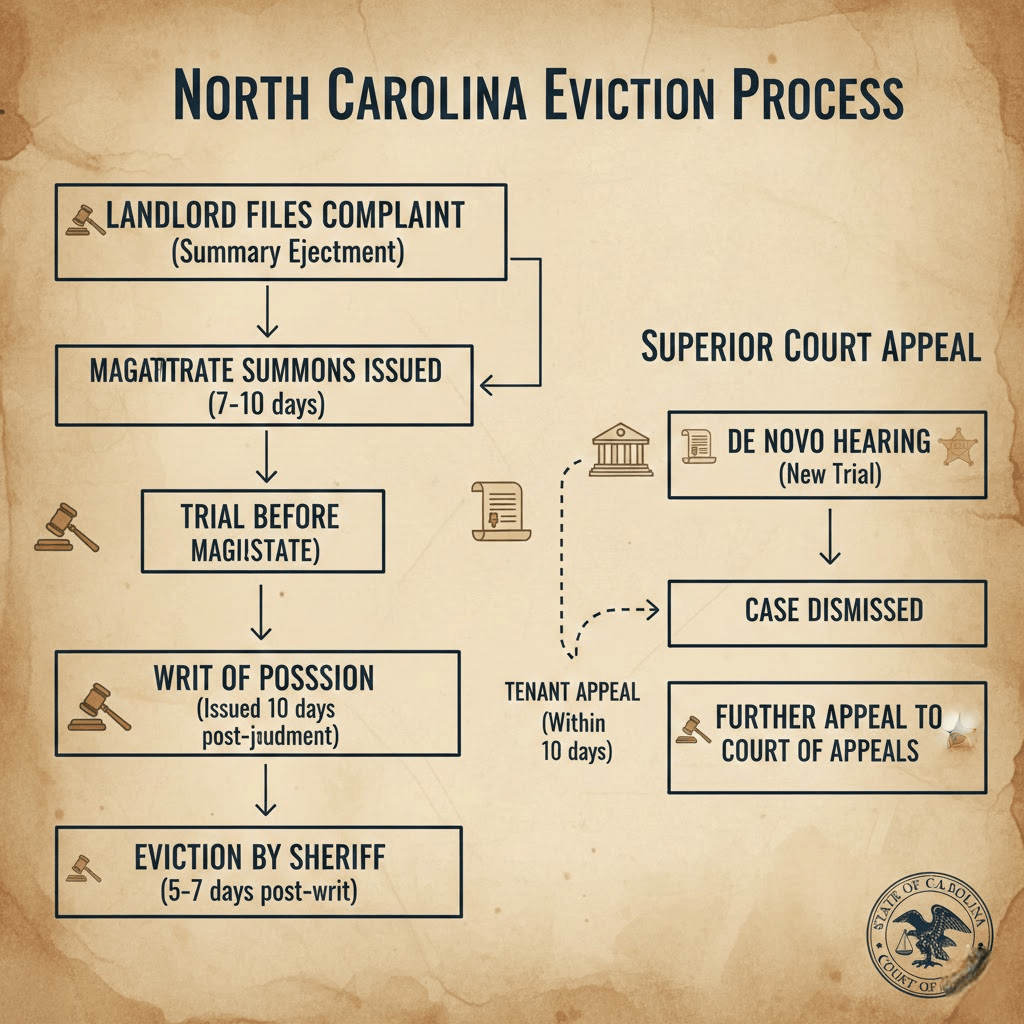
To begin an eviction, a landlord must file a complaint in small claims court and serve the tenant with notice of a hearing. The case is typically heard within 10 days.
“North Carolina law is clear that only the courts can authorize removal,” according to guidance published by Legal Aid of North Carolina, which provides representation to low-income tenants statewide.
Grounds for Eviction
State law allows landlords to pursue eviction for several legally recognized reasons:
- Failure to pay rent
- Holding over after a lease expires
- Material violations of lease terms
- Certain criminal activity linked to the rental property
Each ground must be supported with evidence, and tenants retain the right to contest the claim before a magistrate.
Appeals and Enforcement
If a landlord prevails, tenants generally have 10 days to appeal the ruling. Actual removal may only be carried out by the county sheriff after a writ of possession is issued.
Housing attorneys note that many tenants mistakenly believe eviction is immediate. “There are multiple procedural steps, and missing any of them can invalidate the eviction,” said John Pollock, a housing policy expert at the National Coalition for a Civil Right to Counsel.
Retaliatory Evictions and Tenant Defenses
North Carolina law explicitly prohibits retaliatory evictions, which occur when landlords attempt to remove tenants for asserting legal rights.
Examples include eviction attempts following complaints to housing inspectors, requests for repairs, or participation in tenant associations. Courts may dismiss eviction cases if retaliation is established.
According to the University of North Carolina School of Government, tenants who document complaints and communications significantly improve their ability to assert this defense.
Still, housing advocates caution that retaliation claims can be difficult to prove without records. Written notices, inspection reports, and dated correspondence remain critical.
Rental Repairs in NC: What Landlords Must Fix—and When
Rental repairs in NC fall under the Residential Rental Agreements Act, which requires landlords to provide housing that is “fit and habitable.”
These obligations cannot be waived, even if a lease attempts to shift responsibility to the tenant.
Landlords must maintain:
- Functional plumbing and water systems
- Heating, electrical, and structural safety
- Smoke alarms and carbon monoxide detectors where required
- Sanitary and weatherproof living conditions
“Habitability is a baseline requirement, not a luxury,” said Jim Blackburn, a housing law specialist at Legal Aid of North Carolina.
The Tenant’s Role in Repairs
Tenants are required to notify landlords of needed repairs in a timely manner. Most housing attorneys recommend written notice, such as email or certified mail, to create a record.
North Carolina does not generally allow tenants to withhold rent or make repairs and deduct costs without court approval. Doing so can expose tenants to eviction, even if conditions are poor.
This approach places North Carolina among states with more landlord-favorable repair enforcement mechanisms, according to a 2024 analysis by the National Housing Law Project.
Security Deposits in North Carolina: Limits, Accounts, and Timelines
Security deposits in North Carolina are strictly regulated, with caps based on lease duration:
- Weekly tenancy: up to two weeks’ rent
- Monthly tenancy: up to one and a half months’ rent
- Longer leases: up to two months’ rent
Landlords must hold deposits in a trust account at a licensed financial institution or post a surety bond.
Returning the Deposit
After a tenant vacates, landlords have 30 days to return the deposit or provide an itemized list of deductions. If damages cannot be fully assessed within that period, an interim accounting is required, with final reconciliation due within 60 days.
Permissible deductions include unpaid rent, damage beyond normal wear and tear, and certain re-renting costs. Routine aging—such as worn carpets or minor scuffs—cannot be charged to tenants.
Failure to comply may allow tenants to sue for recovery, according to the North Carolina Administrative Office of the Courts.
How North Carolina Compares Nationally
Compared with other states, North Carolina offers fewer statutory remedies for tenants facing unsafe conditions. Unlike jurisdictions that permit “repair and deduct” or rent escrow systems, North Carolina relies heavily on court enforcement.
Housing policy researchers note that this framework places greater emphasis on legal literacy. “The law assumes tenants understand and can navigate the system,” said Emily Benfer, a housing policy researcher and visiting professor at Georgetown University.
The Impact of Housing Courts and Eviction Trends
Eviction filings in North Carolina remain elevated compared with pre-pandemic levels, according to publicly available court data. Urban counties, including Mecklenburg and Wake, account for a significant share of cases.
Researchers at Princeton University’s Eviction Lab report that eviction disproportionately affects lower-income households, particularly families with children and Black renters.
Housing advocates argue that clearer tenant education and expanded legal assistance could reduce filings and stabilize communities.
Assistance and Legal Resources for Tenants
Several organizations provide housing-related assistance in North Carolina:
- Legal Aid of North Carolina
- NC Justice Center
- Local housing authorities and tenant clinics
- County social services agencies
Some counties operate eviction diversion programs that provide mediation or rental assistance, though availability varies.
What Could Change: Policy Debates and Legislative Outlook
Lawmakers periodically consider reforms to eviction timelines, repair enforcement, and access to counsel. However, no sweeping changes are currently scheduled for the upcoming legislative session.
Landlord groups emphasize the importance of predictable enforcement, while tenant advocates continue to push for expanded protections.
“The challenge is balancing housing supply with human stability,” said a spokesperson for the North Carolina Housing Coalition.
What Tenants and Landlords Should Know Moving Forward
For tenants, understanding rights and documenting issues remains essential. For landlords, compliance with procedural requirements is critical to avoid costly disputes.
Housing attorneys consistently stress early communication as the most effective way to prevent escalation.
FAQ
Can a landlord lock me out in North Carolina?
No. Lockouts and utility shutoffs without a court order are illegal.
Can I withhold rent if repairs are not made?
Generally no. Rent withholding can trigger eviction unless ordered by a court.
How long does a landlord have to return my deposit?
Thirty days, or sixty with an interim accounting.
Closing Perspective
As North Carolina continues to grow, housing law remains a central pillar of economic and social stability. Tenant rights in North Carolina, while procedurally defined, depend heavily on awareness and enforcement.
“Knowing the rules does not guarantee protection,” Blackburn said. “But without that knowledge, tenants often have none at all.”