

Mainstream Vouchers, a federally funded housing assistance program, aim to help non-elderly persons with disabilities afford stable housing in the private rental market. Administered by local public housing agencies and overseen by the U.S. Department of Housing and Urban Development, the program has drawn renewed attention as rising rents, homelessness, and accessibility gaps intensify nationwide.
Table of Contents
What Are Mainstream Vouchers?
Mainstream Vouchers are a specialized form of housing assistance within the federal Housing Choice Voucher program, commonly known as Section 8. While traditional vouchers serve a broad low-income population, Mainstream Vouchers are reserved for non-elderly persons with disabilities, typically adults between ages 18 and 61.
Like other vouchers, the program allows participants to rent privately owned housing while paying a portion of their income—generally about 30 percent—toward rent. The federal government subsidizes the remaining cost through payments to landlords.
HUD describes the program as a tool to promote independent living and reduce reliance on institutional care, aligning housing policy with broader disability rights goals.
The Policy Roots: Disability Rights and Housing
The origins of Mainstream Vouchers are closely tied to the modern disability rights movement. Federal policies such as the Americans with Disabilities Act of 1990 (ADA) and the Olmstead Supreme Court decision of 1999 established the principle that people with disabilities have the right to live in the most integrated setting appropriate.
Housing advocates argue that for decades, federal housing programs disproportionately served seniors, leaving younger adults with disabilities with limited options. Many faced a stark choice between unaffordable private rentals, homelessness, or institutional settings such as nursing facilities.
Mainstream Vouchers emerged as a policy response to that gap, designed to support community-based living rather than segregated care.
Who Qualifies for Mainstream Vouchers?
Eligibility rules are set locally but follow federal guidelines. To qualify, a household must include at least one non-elderly individual with a qualifying disability and meet income limits, typically defined as very low income.
HUD’s definition of disability includes long-term physical, mental, or emotional impairments that substantially limit major life activities and affect independent living. The disabled individual does not need to be the head of household.
Public housing agencies frequently apply additional preferences, prioritizing applicants who are experiencing homelessness, exiting institutions, or at risk of housing instability.
Mainstream Vouchers
| Key Fact | Detail |
|---|---|
| Target group | Non-elderly persons with disabilities |
| Age range | Typically 18–61 |
| Income limits | Very low income households |
| Housing type | Private rental market |
| Program administrator | Local public housing agencies |
Demand Outpaces Supply
Despite expanded funding in recent years, demand for Mainstream Vouchers consistently exceeds supply. Housing authorities across urban and rural areas report long waiting lists, often spanning several years.
According to federal housing data, people with disabilities experience higher rates of poverty and housing instability than the general population. Fixed incomes, rising rents, and a shortage of accessible units compound these challenges.
A Government Accountability Office analysis has found that adults with disabilities are significantly more likely to experience homelessness, even when receiving public benefits.
How the Program Works on the Ground
Once a household receives a Mainstream Voucher, participants are given time to locate suitable housing that meets HUD’s quality standards. Units must pass inspections for safety, habitability, and basic accessibility.
Recognizing the difficulty of finding housing in competitive markets, HUD has issued guidance encouraging agencies to offer longer search periods and higher payment standards, particularly in high-cost regions.
Many agencies also partner with disability service providers to assist with housing searches, landlord outreach, and tenancy support. These partnerships are widely viewed as critical to preventing voucher loss due to administrative or market barriers.
Landlords and the Private Market
The success of Mainstream Vouchers depends heavily on landlord participation. While federal law prohibits discrimination based on disability, acceptance of housing vouchers varies by state and locality.
In some areas, source-of-income protections require landlords to consider voucher holders. In others, landlords may legally refuse vouchers, limiting housing options.
Housing officials say outreach and education efforts have helped improve landlord participation, but competition for affordable units remains intense, especially in urban markets with low vacancy rates.
How Mainstream Vouchers Compare to Other Programs
Mainstream Vouchers differ from other federal housing programs in both scope and intent. Traditional Housing Choice Vouchers serve a broad low-income population, while public housing units are often fixed-location and limited in number.
Project-based rental assistance programs typically tie subsidies to specific developments, whereas Mainstream Vouchers allow for greater geographic flexibility. Advocates say this mobility is essential for access to jobs, healthcare, and support networks.
However, critics note that mobility is limited in practice by market constraints and accessibility shortages.
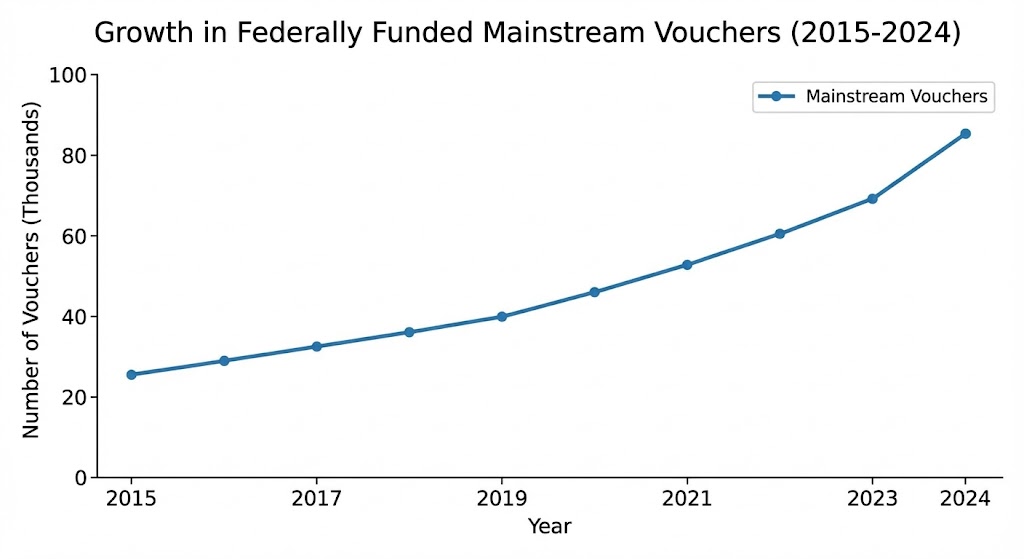
Measuring Impact and Gaps in Data
While housing officials broadly support the program, comprehensive national data on long-term outcomes remain limited. Researchers say more information is needed on housing stability, health outcomes, and cost savings related to reduced institutional care.
Some studies suggest that stable housing can reduce healthcare costs and improve employment outcomes for people with disabilities. However, experts caution that housing alone is not a substitute for adequate healthcare, income support, and community services.
Calls for improved data collection and transparency have grown as funding increases.
Ongoing Policy Debates
Policy discussions around Mainstream Vouchers increasingly focus on scale and equity. Advocates argue that the program remains underfunded relative to need, particularly as housing costs rise faster than disability benefits.
Some lawmakers have proposed expanding voucher availability and strengthening landlord incentive programs. Others emphasize the need to address zoning restrictions and accessibility standards to increase overall housing supply.
Housing officials say coordination across federal, state, and local levels will be essential to achieving meaningful impact.
Looking Ahead
HUD officials say Mainstream Vouchers will continue to play a role in federal housing strategy, particularly as policymakers confront overlapping crises in affordability, homelessness, and healthcare access.
While the program alone cannot resolve systemic housing shortages, many experts view it as a critical component of a broader effort to support independent living and equal opportunity for Americans with disabilities.
FAQ
Are Mainstream Vouchers permanent?
Vouchers are generally ongoing, provided households remain eligible and comply with program rules.
Can families apply?
Yes. The household must include at least one qualifying non-elderly adult with a disability.
Is there a national application process?
No. Applications are handled by local public housing agencies, each with its own waiting list.